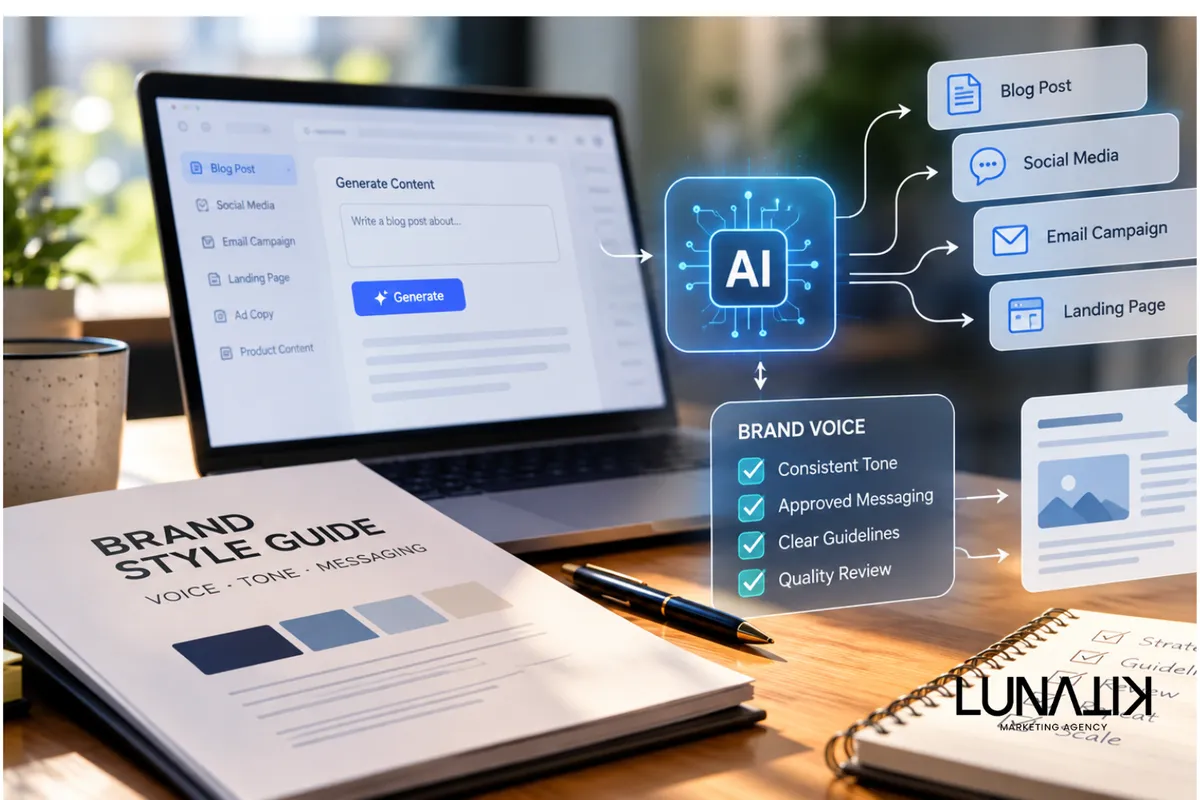
AI Content Creation Without Losing Brand Voice: A Practical Checklist
Yes. Businesses can use AI for AI content creation without losing brand voice by treating AI as a production tool within a governed content system—not as a replacement for brand guidelines or human review. With clear instructions, approved content examples, and consistent quality checks, businesses can produce blogs, emails, and social media posts more efficiently while maintaining their unique tone and messaging. The checklist below outlines the essential assets, decisions, and controls growing businesses need to protect brand voice, improve content quality, and scale production without sacrificing consistency.
Checklist: Practical Review for using AI in Content Production
This checklist is organized as review points you can validate quickly. For each item, mark: Present / Partial / Missing. If multiple items are Missing, pause AI expansion until gaps are resolved. If you need help aligning content to audience and buyer stages, review your Content & Growth Strategy with a clear inventory of who each content piece serves and why: Content & Growth Strategy.
Strategy & governance
Defined content objectives mapped to buyer stages (awareness, consideration, decision) and specific lead actions for each piece.
Documented brand voice brief (tone, vocabulary, sentence length, taboo phrases) with 5–10 concrete examples and counter-examples.
Decision rule: which content types may be fully AI-drafted, which require human-authored originals, and which require final human rewrite.
Ownership: clearly assigned roles for content strategy, writing, editing, legal review, and publishing.
Audience & messaging checks
Buyer persona notes tied to content briefs—primary audience, pain, key objections, proof points, preferred channels.
Message map for priority offers (headline, subhead, proof, call-to-action) that AI outputs must follow.
Checklist item: sample outputs evaluated against persona—do they answer the persona’s question at the intended buyer stage?
Prompting, models, and training
Atomic prompt templates: one template per content type (blog, email, ad, landing page) that includes voice constraints and target buyer stage.
Reference corpus: a curated set of brand-approved content used to fine-tune (or to include as examples in prompts) so outputs align with existing voice.
Model selection rule: criteria for choosing a model or service (cost, latency, safety filters, ability to fine-tune or use retrieval-augmented generation).
Version control for prompts and model settings so changes can be traced to content outcomes.
Voice training assets
Concise style guide (1–2 pages) covering voice traits, forbidden phrasing, punctuation rules, and brand metaphors.
Voice exemplar pack: 6–12 short passages that exemplify correct voice and 3–5 that show common mistakes for contrast.
Scorecard for reviewers: 6–8 criteria (tone match, clarity, accuracy, CTA alignment, buyer-stage fit, brand-safe language).
Human review and editorial workflow
Human-in-the-loop rule: every externally facing asset must pass a named editor before publishing.
Sampling plan: random audit of a defined percentage of AI-generated posts and targeted audit of high-risk topics (legal, pricing, claims).
Approval SLA: maximum time for review and required changes documented to keep content cadence predictable.
Quality assurance and testing
Pre-publish checklist that includes fact-check, citation requirements, and link verification.
Split-test plan for voice variations when experimenting — keep tests small and measure engagement by buyer stage.
Error remediation process for published mistakes (rollback, correction note, and update to prompts/style guide).
Measurement and learning
Track outcomes by buyer stage: leads, MQLs, demo requests, or other stage-appropriate conversion events linked to each content piece.
Content telemetry: collect qualitative reviewer notes and reader engagement metrics to update prompts and exemplars quarterly.
Experiment log: document A/B tests, what changed in prompts or voice constraints, and the result.
Automation, systems, and CRM integration
Template library in your CMS and automation platform so AI outputs fit pre-approved content frames (headlines, meta, body, CTA).
CRM mapping: ensure content-driven actions (form fills, downloads) tag the visitor with buyer stage so follow-up messaging aligns with voice and offer.
Guardrails in automation: route sensitive leads or high-value prospects to human follow-up rather than fully automated sequences.
Deployment checklist: include rollout steps, feature flags for large batches, and rollback options; integrate AI outputs into marketing automation pipelines thoughtfully. For implementation patterns and AI operational considerations, review how AI factors into platform strategy: The AI Advantage.
Tradeoffs and practical implementation considerations
Using AI increases output speed and lowers per-piece cost, but those gains can be negated if brand voice drifts, compliance fails, or conversion drops. Key tradeoffs to evaluate:
Speed versus control: the faster you publish, the stronger your guardrails and review SLAs must be.
Centralization versus decentralization: centralized prompts and exemplars keep voice consistent; decentralized teams can adapt faster but need stricter training and audits.
Fine-tuning versus prompt engineering: fine-tuning a model on brand assets can improve alignment but requires data, governance, and maintenance; robust prompts plus retrieval of brand exemplars can be simpler to manage initially.
Automation depth: automating distribution and CRM tagging improves follow-up but increases risk if content quality varies—start with controlled automations and expand as QA metrics improve.
Before scaling, run a pilot that includes: (1) a short style guide and exemplar pack, (2) three prompt templates, (3) a human editor with a review scorecard, and (4) measurement tied to a single buyer-stage conversion. Use the pilot to validate whether AI output can meet your voice score threshold and business outcomes.
For an operational playbook that connects AI content to lead capture, follow-up, and sales handoff, explore this practical workflow: AI Marketing Workflow.
FAQ
Will AI replace my writers?
No. In most growing businesses AI complements writers by generating drafts, outlines, and variations. Skilled writers and editors remain essential to preserve brand voice, add strategic insight, and handle sensitive topics.
How can I prevent AI from repeating the same phrasing?
Rotate exemplar passages, vary prompt seeds, and include explicit prompt constraints about sentence length and forbidden words. Keep a changelog of prompts and periodically refresh the reference corpus.
What metrics show voice is intact?
Combine quantitative KPIs (engagement by buyer stage, conversion rates) with qualitative reviewer scores from the voice scorecard. A decline in either should trigger prompt or process changes.
How to Plan and Implement a Controlled AI Content Rollout for Sustainable Growth
Growing teams need a clear strategy to scale AI-powered content production without compromising brand voice. At Lunatik Marketing Agency, we help businesses design governed AI content programs that maintain consistency while increasing output. If you want a short audit of your content controls, governance, and automation readiness, we can provide a prioritized checklist of improvements to reduce brand voice risks and streamline production. Start with a discovery session focused on your buyer stages, exemplary content, and automation touchpoints, then develop a controlled pilot that connects content outputs to measurable business outcomes and supports sustainable growth.