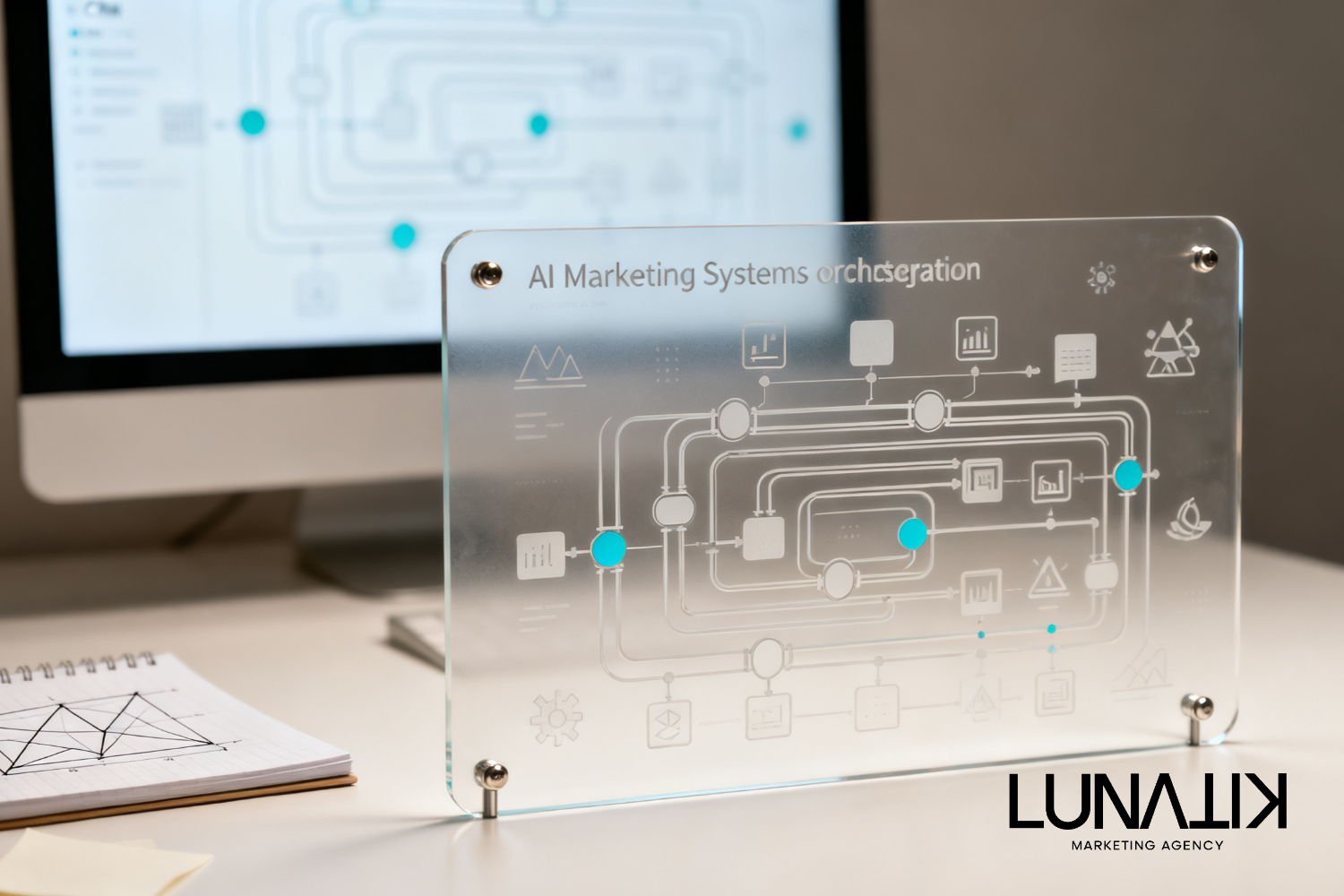
How AI Marketing Automation cuts time and speeds follow-up
Local businesses waste hours on manual follow-up, repetitive campaign tasks, and scattered data. AI speeds routine work and streamlines decision-making, which answers how AI saves time in marketing by enabling ai marketing automation within connected systems like AI Marketing Systems. The result is faster contact response, consistent lead nurturing, and less time spent on low-value tasks.
Decisions stall when teams juggle ads, emails, and spreadsheets without a unified process. That fragmentation slows lead generation, harms the customer experience, and reduces long-term growth. Faster follow-up and predictable workflows matter more than flashy campaigns because quick responses keep leads warm and increase conversion opportunities.
Practical AI-first workflows reduce repetitive work while preserving control over messaging and budgets. Lunatik Marketing Agency builds connected systems that combine CRM automation with workflow automation and paid advertising so teams focus on strategy and high-value execution. That approach creates measurable business productivity gains over time.
Quick Answer
AI saves time in marketing by automating repetitive tasks, accelerating lead follow-up, and prioritizing high-value actions through ai marketing automation. When AI is integrated into CRM automation and workflow automation, it reduces manual touchpoints, shortens sales cycles, and improves business productivity across campaigns and customer journeys.
Key Takeaways
Use ai marketing automation to handle routine tasks like lead scoring and follow-up sequencing.
Integrate CRM automation with ad and website data to cut lead-response time and keep leads engaged.
Automate repetitive creative tests and reporting to free staff for strategy and sales outreach.
Design workflow automation so failures and exceptions route to humans, preserving customer experience.
Measure time saved and conversion impact, not AI features alone.
Quick Business Snapshot
Metric | Notes |
|---|---|
Best For | Local service and professional firms needing faster follow-up |
Business Size | Small to mid-sized teams (5-200 staff) |
Primary Benefit | Reduced manual workload and faster lead response |
Implementation Complexity | Low to medium depending on CRM maturity |
Lunatik Service Fit | |
Typical Environment | CRM + paid ads + website + email/SMS stack |
Who Should Consider This Solution
Service businesses losing leads from slow follow-up and inconsistent nurture.
Teams spending hours on manual data entry, reporting, and campaign setup.
Marketing managers who need predictable lead volume without adding headcount.
Sales teams that want automated prioritization and timely contact prompts.
Businesses ready to connect ads, website, and CRM into repeatable workflows.
How AI Cuts Time Across the Marketing Funnel
AI reduces time by automating repetitive decisions at each funnel stage. For top-of-funnel activities, AI identifies high-potential audience segments and automates ad creative testing so a human operator spends fewer hours on manual split tests. Mid-funnel, automated lead scoring and segmentation route contacts to the right email and SMS sequences. Bottom-of-funnel, AI surfaces negotiation cues and follow-up reminders so salespeople spend time on conversations that matter. This combination of ad, content, and CRM automation turns slow manual cycles into fast, repeatable processes that improve business productivity and consistent lead flow.
Speeding Lead Follow-Up with CRM Automation
Automated CRM processes answer the single biggest time sink: manual follow-up. CRM automation can instantaneously log leads from ads or website forms, assign priority scores, and trigger context-aware messages that match the lead source and intent. That reduces response lag from days to minutes without losing personalization. The business impact is straightforward: faster contact and tailored next steps improve conversion odds and reduce time wasted chasing cold contacts. Proper CRM automation requires clear field structure, consistent tagging, and rules for exception handling so the automation supports, not overrides, human judgment.
Reducing Repetitive Work with Workflow Automation
Workflow automation removes manual handoffs between marketing, sales, and operations. Tasks like campaign setup, creative refreshes, reporting exports, and lead routing are ideal candidates. Automating these processes frees staff to focus on strategic priorities and customer conversations. The key tradeoff is initial mapping effort: documenting every step before automation takes time up front but saves multiples thereafter. Prioritize automating high-frequency, low-variation tasks first. Combine automation with clear monitoring so failures trigger alerts and human review rather than silent errors that damage customer experience.
Automating Content and Paid Advertising Tasks
AI speeds creative testing and routine ad maintenance without replacing human judgment. Use AI to generate ad variants, headline suggestions, and landing page copy experiments, then let automation rotate and measure performance. Scheduling, bid adjustments, and budget pacing can be automated based on rules and predictive signals to reduce hands-on bidding work. The business impact is consistent performance with fewer manual hours; the tradeoff is needing guardrails to prevent wasteful automatic changes. Maintain control by setting thresholds and exception rules that pause automation and ask for human approval when spend or performance drift occurs.
Measuring and Optimizing Faster with AI Analytics
AI shortens analysis cycles by automatically pulling and normalizing data across ad platforms, CRM systems, and website analytics. Instead of manually reconciling spreadsheets, AI systems surface which channels and campaigns move leads through the funnel. That accelerates decision loops so optimizations happen faster and with less effort. For businesses, the practical outcome is quicker course corrections and clearer visibility into time-to-conversion. Implementation requires consistent event tracking and a single source of truth so AI models draw accurate conclusions rather than amplifying bad data.
A Practical Example
Scenario: a mid-sized HVAC company sees inconsistent lead response times and rising ad spend with flat conversions. The marketing challenge is rapid response and proper lead routing. Decision: integrate ad leads to the CRM, apply AI lead scoring, and create automated follow-up sequences by intent and job type. Lunatik's AI Marketing Systems supports this by mapping the ad-to-CRM flow, setting lead scoring and routing rules, and automating SMS/email sequences. The result is reduced lag between lead capture and first contact, clearer handoffs to technicians, and fewer missed appointments. This example shows how CRM automation and workflow automation work together to improve customer experience and business productivity without adding staff.
Practical Checklist
Audit current lead sources and identify where manual work consumes most time.
Standardize CRM fields and tagging so automation has reliable inputs.
Implement lead capture to CRM with immediate routing and scoring rules.
Build short automated follow-up sequences for new leads using email and SMS.
Automate ad creative testing and schedule routine performance reports.
Set monitoring and exception alerts so humans review edge cases.
Measure time-to-first-contact and conversion lift as primary KPIs.
Comparison: Manual Follow-Up vs CRM Automation
Aspect | Manual Follow-Up | CRM Automation |
|---|---|---|
Response Time | Hours to days | Minutes to hours |
Consistency | Variable | Predictable |
Human Hours | High | Low |
Scalability | Poor | Strong |
Error Rate | Higher due to manual entry | Lower with validation rules |
What Lunatik Marketing Agency Recommends
Begin with an operational audit that maps where leads enter the system and how they move through to outcome. Identify the highest-frequency manual tasks, then apply ai marketing automation for lead capture, lead scoring, and initial contact. Integrate CRM automation with ad data and website events to reduce response time and improve lead qualification. Balance automation with human checks and prioritize metrics tied to real business outcomes such as time-to-first-contact and lead-to-appointment conversion. For teams needing a guided implementation, explore Lunatik's documented playbooks and AI Marketing Workflow examples to speed deployment while minimizing disruption.
Common Mistakes to Avoid
Automating without cleaning data first — avoid bad decisions by standardizing CRM fields before automation.
Over-automation — keep humans in the loop for edge cases and complex negotiations.
No monitoring or alerts — set clear exception rules so automation failures are visible and fixed quickly.
Poor tagging of lead sources — maintain consistent UTM and source tags to ensure correct routing and attribution.
Not measuring time savings — track time-to-contact and staff hours saved to evaluate business productivity gains.
Frequently Asked Questions
How quickly can AI save time in a marketing team?
AI can deliver measurable time savings within weeks for specific tasks such as lead routing, automated follow-up, and ad testing. Realistic gains depend on existing data quality and the scope of automation. Start with high-frequency tasks and iterate to expand automation once monitoring and controls are in place.
Will AI replace marketing staff?
AI reduces repetitive work but does not replace strategic roles. It reallocates time from manual tasks to higher-value activities like creative strategy and customer conversations. The practical outcome is higher productivity and better use of existing staff rather than wholesale replacement.
What are the common technical barriers to implementing ai marketing automation?
Common barriers include inconsistent CRM data, missing lead source tracking, and disconnected platforms. Address these by standardizing data fields, ensuring reliable form-to-CRM integrations, and using middleware or APIs to create stable connections between systems.
How does AI improve the customer experience?
AI speeds response times, personalizes initial messages, and routes inquiries to the right people. Faster and more relevant communication reduces friction for customers and creates a smoother handoff to sales or operations, improving satisfaction and conversion likelihood.
Which metrics should be monitored after automating marketing tasks?
Monitor time-to-first-contact, lead-to-appointment conversion, follow-up completion rates, and staff hours saved. Also track cost per lead and cost per conversion across channels to ensure automation is improving both efficiency and effectiveness.
Final Thoughts on Time and Automation
Time saved through ai marketing automation converts directly into more customer conversations, better responsiveness, and clearer growth signals. Focus on automating repetitive tasks first, then expand automation into decision-support areas while preserving human oversight for complex interactions.
Why Trust Lunatik Marketing Agency
Capability | Focus |
|---|---|
AI-driven marketing approach | Practical systems that reduce manual work |
Lead generation expertise | Connected campaigns and performance focus |
CRM automation expertise | Design and implementation of lead routing and scoring |
Paid advertising management | Ad optimization tied to CRM outcomes |
Website optimization expertise | Conversion-focused pages and tracking |
Customer-first philosophy | Automation designed to improve experience |
Next Steps for Time Savings
At Lunatik Marketing Agency, evaluating current lead flows, identifying the highest-frequency manual tasks, and prioritizing simple automations help shorten response times. Our team helps you review integration points between ads, your website, and your CRM while taking a structured approach to AI marketing systems that aligns implementation options, the customer journey, and follow-up processes with your business goals. Explore how you can Strengthen Your Marketing Automation .