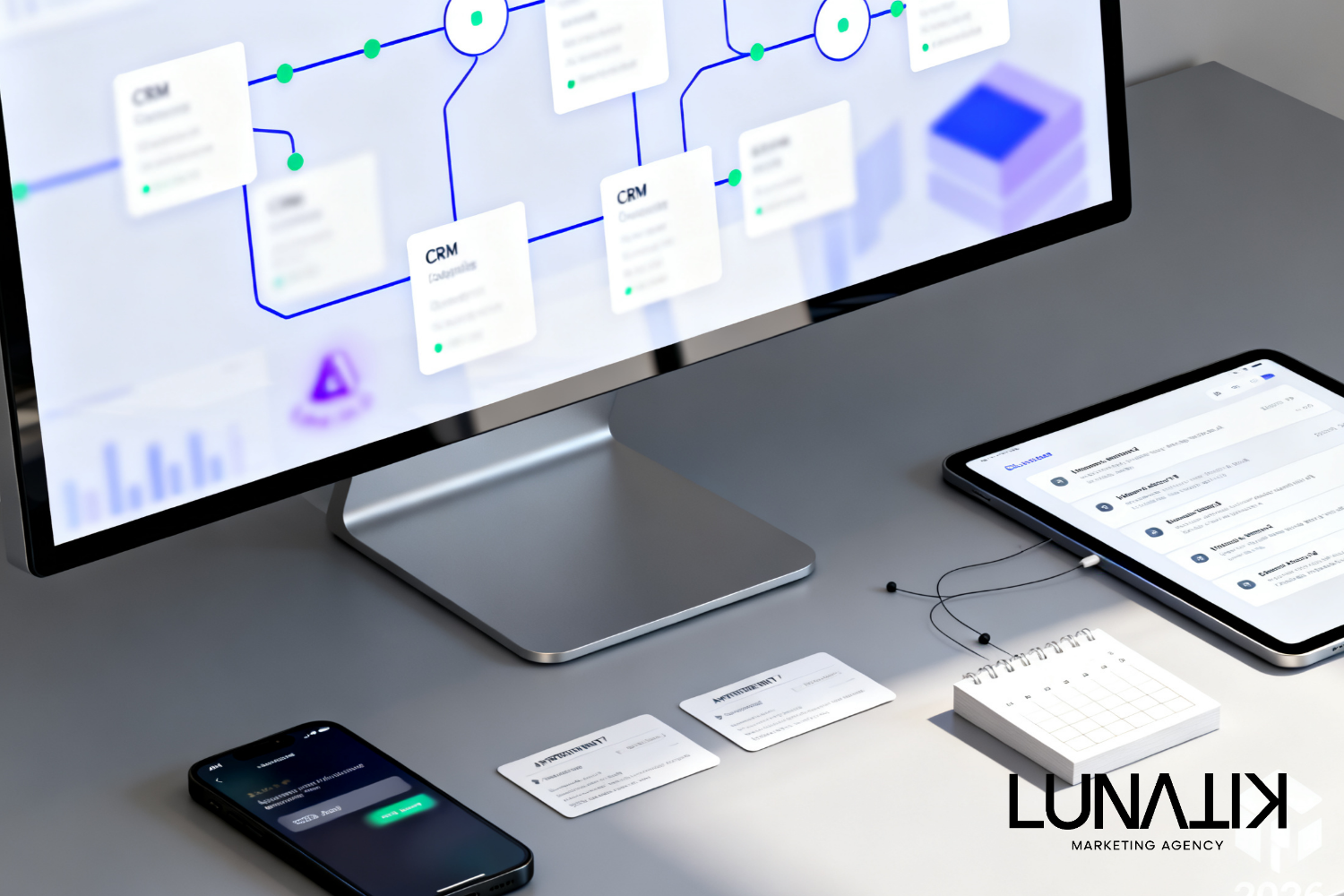
Email vs SMS Marketing: Choose the Right Channel With CRM
Most local businesses face the same decision: should follow-up depend on email or SMS? The practical answer is not one-size-fits-all. In the email vs sms marketing debate, Email Marketing remains the backbone for detailed lead nurturing, content, and sequence-based automation, while SMS excels at urgent, short-form prompts and time-sensitive confirmations.
Businesses struggle because both channels feel essential and yet behave differently. Choosing incorrectly fragments customer communication, slows lead follow-up, and reduces conversion predictability. A unified view of lead generation, follow-up speed, and customer experience clarifies which channel leads in each part of the funnel.
Begin by mapping customer journeys and response expectations rather than picking a favorite channel. Lunatik Marketing Agency builds AI-driven systems that connect Email Marketing with SMS where it makes business sense, improving response times and long-term growth. The most reliable systems match channel to intent and automate the transitions between them.
Quick Answer
Email and SMS are complementary. Use email for longer-form nurturing, onboarding, and content-driven sequences; use SMS for confirmations, high-urgency reminders, and short calls to action. Combine both inside marketing automation and CRM workflows to convert more leads faster.
Key Takeaways
- Map the customer journey first, then assign email or SMS by intent and timing.
- Email is best for detailed nurture sequences, documentation, and sustained engagement.
- SMS works for urgent prompts, appointment reminders, and short CTAs that need immediate action.
- Use CRM automation to coordinate both channels and prevent duplicate or conflicting outreach.
- Respect compliance and opt-in rules for each channel to maintain deliverability and trust.
Quick Business Snapshot
| Best For | Lead nurturing (email) and urgent reminders (SMS) |
|---|---|
| Business Size | Small to medium service businesses and growing local firms |
| Primary Benefit | Faster follow-up and predictable lead conversion |
| Implementation Complexity | Low to medium with CRM automation |
| Lunatik Service Fit | Email Marketing |
| Typical Environment | CRM-driven sales teams, appointment-based services, and local contractors |
Who Should Consider This Solution
- Service businesses that need reliable appointment confirmations and quick reminders.
- Professional firms that rely on content-led nurturing to convert prospects.
- Contractors and home services with on-site scheduling and day-of updates.
- Sales teams that need faster lead follow-up without adding manual work.
- Any local business looking to automate cross-channel touchpoints inside a CRM.
How channel choice affects lead nurturing
Use email when the objective is education, relationship building, or multi-step nurturing. Email holds more content and remains the best place to deliver proposals, case details, onboarding sequences, and longer-form content that supports decision making. For marketing automation, email sequences can span days or weeks and include branching logic based on open, click, and conversion behavior.
For the business impact, an email-first nurture reduces manual follow-up and gives prospects time to evaluate offers. Automation ensures consistent timing, preserves thread history inside the CRM, and enables scoring. That prepares leads for higher-velocity touchpoints—like SMS—that prompt immediate action.
When SMS should lead and when it should not
Use SMS when the message must be seen and acted upon quickly. Appointment reminders, short confirmations, cancellation alerts, and narrow-time promotions fit SMS best. The business impact is immediate: reduced no-shows, faster confirmations, and a clearer day-of schedule for service teams.
SMS should not replace email for complex information or contractual communications. Regulatory requirements and character limits make SMS a blunt instrument for sustained nurturing. Treat it as a tactical channel inside a broader automated system rather than a standalone strategy.
Integration and automation: why CRM matters more than the channel
Integration matters more than choosing email or SMS alone. A CRM that connects both channels ensures messages are coordinated, prevents overlap, and tracks responses in one place. Automation can route hot leads to sales, schedule follow-ups, and trigger either email or SMS based on behavior.
From a business perspective, connected workflows reduce manual errors and speed follow-up. Technical setup involves API-based SMS providers, an email service, and automation rules inside the CRM. For teams that need help designing those rules, an AI Marketing Workflow can map and automate decision points to match business priorities.
Personalization, segmentation, and signal use
Personalized and segmented campaigns outperform generic blasts. Use email to deliver segmented content and use SMS to send targeted, time-sensitive nudges. Email allows deeper personalization with dynamic content, while SMS personalization must be concise and focused on single actions.
Business impact: segmentation improves conversion and reduces complaints. Signals such as recent website visits, quote requests, and appointment cancellations should trigger different channel mixes. Tie those signals into the CRM to automate whether a lead gets an email sequence, an SMS nudge, or both.
Cost, compliance, and deliverability tradeoffs
Cost and compliance differ between channels and must be weighed against business goals. Email tends to be cheaper at scale and easier to archive for records. SMS has higher per-message costs and stricter opt-in rules that require careful consent management.
From a practical standpoint, budget constraints may push heavier use of email for long-term nurturing and reserve SMS for high-value or time-sensitive communications. Maintain opt-in records, include clear unsubscribe paths, and monitor deliverability to protect sender reputation across both channels.
A Practical Example
Combine email and SMS inside a CRM-driven workflow for predictable results. A local HVAC company that captures leads from a website form faces the marketing challenge of turning website inquiries into scheduled diagnostics while avoiding missed appointments.
The decision: use an email sequence to educate prospects about service tiers and expected pricing, and use SMS for immediate confirmation and the day-before reminder. Email sequences provide documentation and nurture; SMS secures the appointment. The selected Lunatik Email Marketing service ties both channels into the CRM, automates rules for sending SMS only after consent, and records responses so the sales team sees the full history.
Comparison: Email vs SMS Marketing
| Feature | SMS | |
|---|---|---|
| Best for | Long-form nurture, documentation, onboarding | Urgent reminders, short CTAs, confirmations |
| Message length | Long-form with attachments and links | Short, single-action prompts |
| Regulatory complexity | Moderate; unsubscribe compliance | Higher; strict opt-in and TCPA considerations |
| Typical funnel role | Top and middle funnel nurture | Bottom funnel action and logistics |
| Integration with CRM | Excellent for tracking and sequences | Effective for confirmations and alerts |
Practical Checklist
- Map the customer journey and mark moments that need fast responses.
- Collect explicit opt-in consent for SMS and clear unsubscribe options for email.
- Set up CRM tags and automations so channel choice is rule-driven, not manual.
- Create email nurture sequences for education and proposal delivery.
- Design SMS templates for confirmations, reminders, and short CTAs.
- Route hot leads from email engagement to SMS follow-up when timing demands.
- Monitor deliverability, opt-outs, and response rates to refine timing and content.
What Lunatik Marketing Agency Recommends
Start by organizing leads inside a CRM and mapping the sequence of touches by customer intent. Use Email Marketing to build multi-step nurture flows and reserve SMS for high-urgency touchpoints. Align automation so that email engagement triggers SMS only when appropriate, and enforce consent rules to protect deliverability. Integrate an AI Marketing Workflow to prioritize leads and reduce manual triage. Connect systems with the list of tools in Software We Work With to keep data flowing and follow-up predictable.
Common Mistakes to Avoid
- Sending SMS without clear consent. Avoid by recording opt-ins and using verified providers.
- Using SMS for complex info. Avoid by moving details to email and keeping SMS short.
- Running uncoordinated cross-channel campaigns. Avoid by centralizing logic in the CRM.
- Not tracking channel performance together. Avoid by logging all interactions in one place.
- Neglecting unsubscribe and opt-out hygiene. Avoid by automating suppression lists and honoring requests immediately.
Frequently Asked Questions
Which channel produces faster responses?
SMS typically produces faster immediate responses because messages land directly on the recipient's phone as a brief CTA. For time-sensitive confirmations and reminders, SMS is more effective. For considered decisions and content-rich interactions, email supports longer engagement and referenceable documentation.
How should opt-in collection differ for email and SMS?
Email opt-ins can be collected through forms and double opt-in sequences. SMS requires explicit consent captured at the point of collection and stored with the contact record. Maintain these records in the CRM and use automation to respect user preferences across channels.
Can both channels be automated together?
Yes. Automation rules in a CRM can trigger email sequences or SMS messages based on behavior, time, or lead score. Coordinate triggers so actions are not duplicated and ensure messaging is consistent across channels.
Is SMS or email cheaper to run?
Email is generally more cost-effective at scale because per-message costs are lower. SMS has higher per-message costs, so reserve it for high-value, time-sensitive communications where immediacy justifies the expense.
How to measure success when using both channels?
Measure success by tracking lead conversion rates, time to appointment, and engagement signals across both channels in the CRM. Use automation to tag outcomes and compare paths that used email-only, SMS-only, or both to determine the most effective mix for the business.
Final thoughts on channel strategy
Match communication channel to customer intent and timing. When email handles depth and SMS handles urgency inside a connected CRM, follow-up becomes faster, clearer, and more reliable. Designing rules before tools keeps the focus on predictable business outcomes.
| Why Trust Lunatik Marketing Agency | |
|---|---|
| AI-driven marketing approach | Applies AI workflows to prioritize leads and automate follow-up |
| Lead generation expertise | Designs connected campaigns to build predictable pipelines |
| CRM automation expertise | Implements rules that coordinate email and SMS inside a single record |
| Paid advertising management | Aligns paid campaigns to feed automated nurture sequences |
| Website optimization expertise | Keeps landing pages and forms aligned with follow-up systems |
| Customer-first marketing philosophy | Prioritizes timely, respectful outreach that improves customer experience |
At Lunatik Marketing Agency, start with the customer journey before choosing channels
At Lunatik Marketing Agency, channel selection begins with the business, customer journey, and follow-up process. Recommendations focus on organizing CRM data, automating decision rules, and using email for depth with SMS for urgency. For help aligning automation, testing messaging mixes, and building predictable follow-up processes, Strengthen Email Marketing. Understand the customer touchpoints and the timing of intent before committing to a channel strategy.