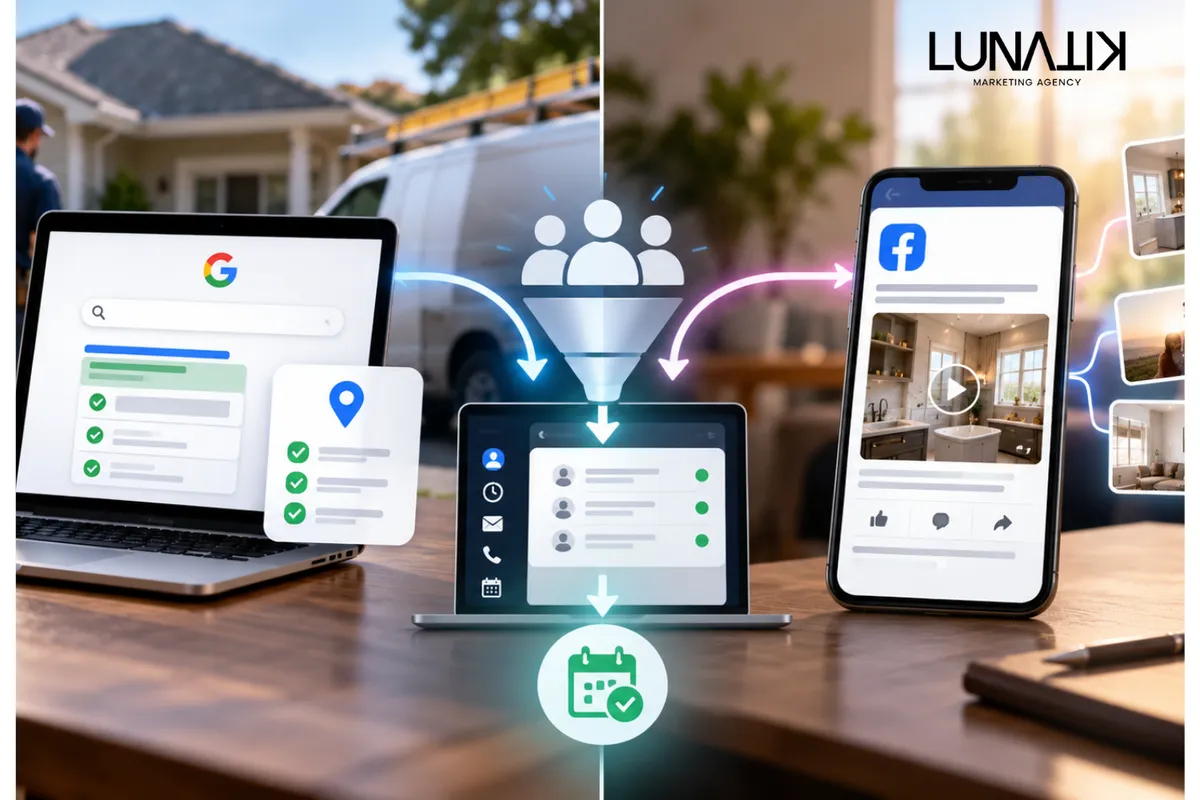
Lead Generation: Google Ads vs Facebook Ads Explained
Many local businesses face a binary choice when starting paid campaigns: choose Google Ads or Facebook Ads. The right answer depends on where potential customers are in the buying process, the business’s lead value, and how follow-up is organized. For a practical evaluation of Google Ads vs Facebook Ads, focus on predictable lead generation systems rather than platform preference alone, and align campaigns with a clear CRM follow-up plan.
Confusion often comes from comparing click costs or platform features without considering customer intent, follow-up speed, and conversion touchpoints. Paid advertising needs to feed a fast, automated lead lifecycle so that leads generated by ads become appointments or sales instead of dead leads in an inbox. That’s why matching channel selection to business operations matters more than choosing one platform because it looks cheaper.
Lunatik Marketing Agency builds AI-first marketing systems that connect paid ads, websites, and CRM automation to support consistent growth. Evaluating Google Ads vs Facebook Ads starts with campaign goals, customer intent, and available follow-up processes. The best decision is the one that supports predictable lead flow and faster contact with prospects.
Quick Answer
Google Ads is typically better for capturing high-intent, bottom-of-funnel searches where people actively seek services. Facebook Ads is often stronger for discovery, awareness, and audience-based lead nurturing. For many local businesses, the best outcome comes from using both platforms in coordinated ways tied to CRM-driven follow-up and a focused Lead Generation strategy.
Key Takeaways
- Match Google Ads to search intent and immediate demand; use Facebook Ads for discovery and audience building.
- Measure leads by qualified appointments and closed revenue, not just clicks or impressions.
- Fast, automated follow-up increases conversion from both platforms.
- Budget across platforms based on cost per qualified lead and capacity to nurture new contacts.
- Combine creative testing on Facebook with intent capture on Google for a predictable funnel.
Quick Business Snapshot
| Category | Details |
|---|---|
| Best For | Local leads from search (Google) and audience outreach (Facebook) |
| Business Size | Small to mid-size local service businesses |
| Primary Benefit | Predictable inbound leads when tied to CRM follow-up |
| Implementation Complexity | Moderate — requires tracking, landing pages, and CRM automation |
| Lunatik Service Fit | Lead Generation and CRM automation integration |
| Typical Environment | Local service firms with appointment-based sales |
Who Should Consider This Solution
- Contractors and home service companies that need booked appointments from search or social exposure.
- Professional service firms that want to convert discovery-stage prospects into consults.
- Businesses with a CRM or willingness to adopt one for automated follow-up.
- Local shops that can track calls, forms, or booked jobs as primary lead actions.
How Google Ads and Facebook Ads Differ
Google Ads answers explicit demand. When someone searches for "emergency plumber near me" they are signaling immediate intent and are often ready to act. That makes Google Ads a strong channel for closing near-term opportunities and for keywords tied to services. Facebook Ads works differently by surfacing offers to people who match target profiles or interests. It excels at generating awareness, building lists, and nurturing prospects who are not actively searching. Both channels can generate leads, but their roles in the buyer journey differ. Choose the platform whose role best matches the business’s current conversion capability and the speed of its follow-up process.
Audience Intent and Buying Stages
Direct purchase intent is the biggest differentiator. Search traffic tends to be lower funnel and converts faster, while social traffic often requires multi-touch nurture. For businesses with short sales cycles and staff to follow up quickly, Google search campaigns produce measurable results sooner. When the sale requires relationship building or multiple contacts, Facebook’s creative and audience tools let the brand stay visible during the nurture phase. Tests should track qualified leads through the funnel so the true cost per appointment or sale — not per click — guides budget allocation.
Budget, Bidding, and Measurement
Budget decisions should flow from cost per qualified lead instead of CPC. Google’s keyword bidding is auction-driven around intent; competitive service categories can have higher CPCs but also higher conversion rates. Facebook typically has lower CPMs and CPCs for broad outreach but may need more touches before conversion. Set up conversion tracking that records booked appointments, form completions, or phone calls. Without accurate tracking, it is impossible to compare Google Ads vs Facebook Ads on equal footing. Track leads into the CRM and measure downstream revenue where possible.
Ad Creative and Message Testing
Creative needs differ by channel. Google text or responsive search ads should focus on clear service offers, local availability, and call extensions for immediate action. Facebook creative can use imagery, short video, or carousel formats to explain value and build familiarity. Run structured tests: test offer, headline, and call-to-action separately. Use Facebook to warm audiences, then retarget with search or intent-based campaigns. That combination reduces wasted spend by improving landing page conversion rates when searchers arrive.
Campaign Implementation and Automation
Start with the customer journey and automate the handoff from ad click to booked appointment. Integrating paid ads with a website and CRM eliminates manual follow-up and speeds response times. Automations can assign leads, send immediate confirmation SMS or email, and trigger appointment reminders. Use audience signals from both platforms to feed back into targeting, while storing lead attributes in the CRM for segmentation. Where AI can help, use predictive lead scoring to prioritize high-value inquiries and rule-based workflows to route them. An AI Marketing Workflow makes these connections practical for local teams by centralizing data and automating next-best actions.
A Practical Example
Situation: A mid-size local roofing contractor sees steady seasonal search traffic but inconsistent new-job bookings. Challenge: Search conversions drop when call volume spikes and leads are not followed up quickly. Decision: Invest in Google search campaigns for high-intent keywords and use Facebook to retarget visitors who viewed project galleries. How the Lunatik Service supports this decision: Implementing a connected lead capture page, immediate SMS confirmation, and automated CRM task creation ensures every ad-generated lead is contacted quickly, supporting more booked inspections and smoother revenue across the season.
Comparison: Google Ads vs Facebook Ads
| Feature | Google Ads | Facebook Ads |
|---|---|---|
| Primary Strength | High-intent search capture | Audience reach and nurture |
| Best Use | Immediate service queries | Brand awareness and retargeting |
| Typical Cost Pattern | Higher CPC for competitive keywords | Lower CPC/CPM for broad targeting |
| Conversion Path | One or two steps to contact | Often multi-touch nurture |
| Measurement Focus | Appointments and calls | Engagement, leads, and list growth |
Practical Checklist
- Define primary conversion (call, form, booking) and track it in the CRM.
- Map buyer intent to channel: assign search for immediate intent and social for discovery.
- Build focused landing pages that match ad messaging and reduce friction.
- Automate immediate lead acknowledgments via SMS or email to improve response times.
- Set up attribution and measure cost per qualified lead, not just clicks.
- Run a 30- to 90-day test with matched budgets and monitor qualified lead volume and conversion rates.
Businesses looking for additional marketing insights can also read The AI Advantage for more practical guidance.
What Lunatik Marketing Agency Recommends
Prioritize the process before the platform. Identify the business’s highest-value lead action and instrument the funnel end-to-end so paid ads feed a reliable CRM workflow. Use Google Ads to capture immediate demand and Facebook Ads to expand reach and retarget warm audiences. Automate confirmations and reminders, and use lead scoring to surface high-probability prospects. Test both platforms with clear tracking, then reallocate budget to the channel delivering the best cost per qualified lead. This approach focuses on operational readiness and long-term predictability rather than chasing lower CPCs.
Common Mistakes to Avoid
- Optimizing for clicks instead of qualified leads — fix by tracking appointments and closed business.
- Running campaigns without CRM follow-up — fix by creating automated touchpoints and lead routing.
- Using identical creative for both platforms — fix by tailoring messages to intent and placement.
- Neglecting landing page relevance — fix by aligning ad copy, offer, and page experience.
- Ignoring attribution windows — fix by reviewing conversion paths and assigning value to multi-touch journeys.
Frequently Asked Questions
Which platform generates leads faster for local services?
Direct response from search typically converts faster for local services because searchers show immediate intent. Google Ads often delivers quicker appointments when campaigns are set up with local extensions, call tracking, and immediate follow-up. Speed still depends on how fast leads are contacted and whether landing pages reduce friction.
Can Facebook Ads replace Google Ads for lead generation?
Facebook Ads can produce strong leads but usually requires more nurturing and multiple touches. For businesses that rely on immediate service calls, Facebook alone may not replace search. A combined approach—awareness on Facebook and intent capture on Google—often yields better overall results when measurement and follow-up are in place.
How should budget be split between Google and Facebook?
Budget allocation should be driven by cost per qualified lead and business capacity to handle leads. Start with test budgets on both platforms, measure qualified lead costs, and shift spend to the channel that delivers better lead quality relative to price and closure rates. Adjust for seasonality and campaign performance.
What tracking is essential for comparing performance?
Track form submissions, phone calls, booked appointments, and downstream revenue when possible. Use CRM tags to mark leads from each channel, implement call tracking, and ensure landing pages have proper analytics. Accurate lead-level attribution is required to compare Google Ads vs Facebook Ads fairly.
Is one platform better for high-value jobs?
High-value jobs often involve longer decision cycles. Facebook can help maintain visibility during the decision process, while Google captures active searches at critical moments. For high-ticket services, coordinate both platforms and emphasize CRM-led nurture and consult scheduling to move prospects toward purchase.
Final Thoughts on Platform Choice
Platform selection is less about preference and more about aligning channel roles with customer intent, operational capacity, and rapid follow-up. When ads feed an organized CRM and automated workflows, both Google Ads and Facebook Ads can contribute to predictable growth.
Why Trust Lunatik Marketing Agency
| Capability | Practical Focus |
|---|---|
| AI-driven marketing approach | Use AI where it improves lead prioritization and workflow automation |
| Lead generation expertise | Design campaigns to produce appointment-ready inquiries |
| CRM automation expertise | Automate lead routing, confirmations, and reminders |
| Paid advertising management | Coordinate search and social for end-to-end funnels |
| Website optimization | Improve landing experiences to raise conversion rates |
| Customer-first marketing philosophy | Focus on response speed and consistent buyer experience |
Platform Selection in Local Advertising
At Lunatik Marketing Agency, the recommendation is to test both platforms within a connected marketing system and measure outcomes at the lead and appointment level; implement CRM automation and rapid follow-up to convert interest into booked jobs, and use data from tests to shift budget toward the channel delivering the best qualified lead flow while preserving the overall customer experience. Improve Lead Generation