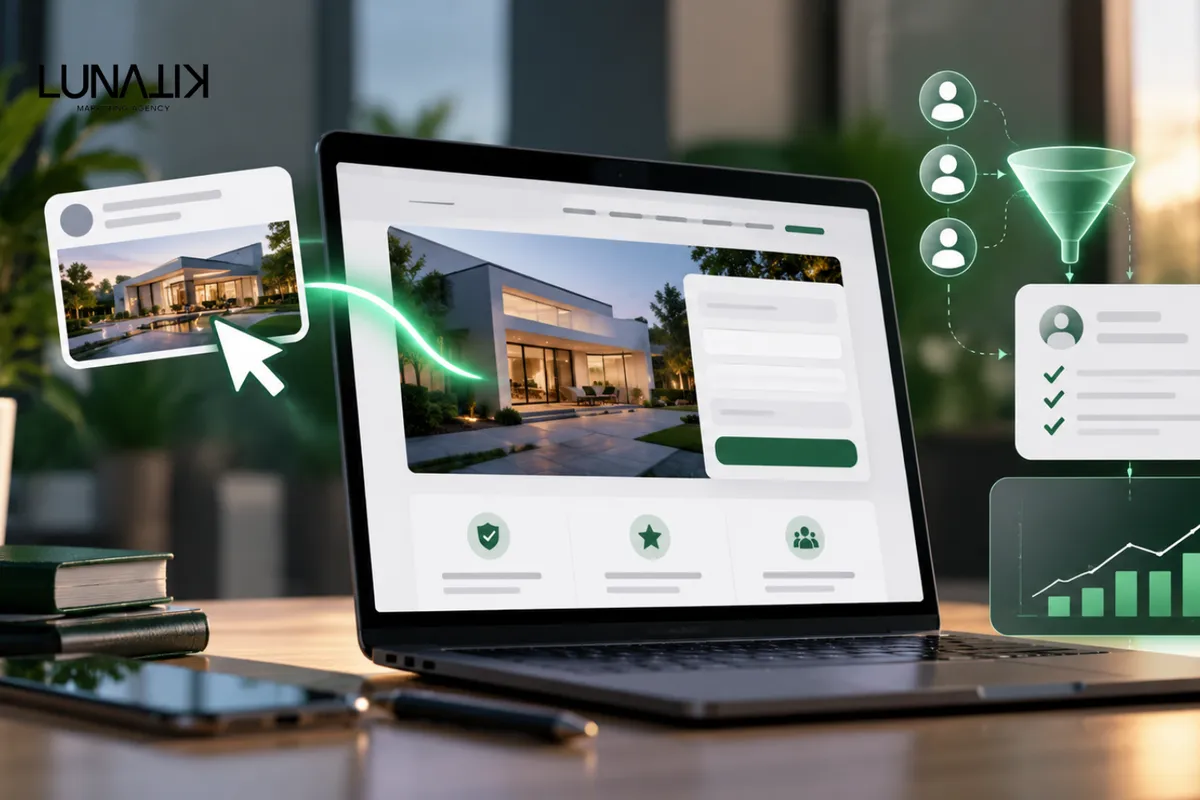
Landing Page Optimization: What Makes a Good Page
Well-designed landing pages directly answer a visitor's question and make it simple to take the next step. A good landing page removes distraction, highlights the offer, and uses landing page optimization to convert traffic into website leads through clear headlines, focused copy, and a single conversion goal tied to the business objective under Web Design & Digital Presence.
Many websites struggle because they serve too many purposes at once: general information, blogs, and forms clutter the path to conversion. That leads to slow follow-up, lost leads, and inconsistent growth. Faster lead capture and follow-up systems mean fewer missed opportunities and a better customer experience.
Technical fixes alone do not solve conversion problems. Effective landing pages pair simple UX choices with CRM automation, measurement, and targeted ad or email traffic. Lunatik Marketing Agency uses an AI-first systems approach that connects landing page optimization to follow-up workflows, so lead capture becomes a predictable driver of revenue.
Quick Answer
A good landing page focuses on one clear offer, reduces distractions, answers visitor objections, and makes the next action obvious. Use a single headline, focused copy, a visible call to action, social proof, and a short form to improve conversion optimization and generate reliable website leads.
Key Takeaways
- Match the page to the visitor's intent and remove navigation that distracts from the conversion goal.
- Prioritize load speed, headline clarity, and a single, visible call to action for better landing page optimization.
- Use short forms, progressive profiling, and immediate CRM triggers to capture and qualify leads.
- Test one variable at a time and measure impact on downstream lead quality and conversion rates.
- Connect landing pages to automation so leads receive faster follow-up and fewer leads fall through the cracks.
Quick Business Snapshot
| Category | Details |
|---|---|
| Best For | Local service businesses needing predictable lead capture |
| Business Size | Small to mid-size companies and regional franchises |
| Primary Benefit | Improved conversion optimization and faster lead follow-up |
| Implementation Complexity | Low to moderate depending on CRM integration |
| Lunatik Service Fit | Web Design & Digital Presence |
| Typical Environment | PPC campaigns, email traffic, organic search landing pages |
Who Should Consider This Solution
- Contractors and home service firms that need more qualified inbound leads.
- Professional service providers who want simple forms with faster follow-up.
- Local businesses running paid ads that need better landing-to-lead conversion.
- Companies with slow or manual lead qualification processes that lose prospects.
- Marketing managers wanting predictable funnels tied to CRM outcomes.
What makes a high-converting landing page?
A high-converting landing page has clarity as its primary function. The headline must reflect the ad or link that sent the visitor there, the subheadline must explain the immediate value, and the primary call to action needs to be the clearest visual element on the page. Design choices that help landing page optimization include limiting navigation, using whitespace to direct attention, and placing the form above the fold when appropriate.
Copy must anticipate the buyer's questions: credentials, cost signals, timeline expectations, and a simple next step. Social proof—short testimonials, badges, or numeric counts—should support credibility without overwhelming the primary message. For complex services, use progressive disclosure: a short form to capture the initial lead, followed by an automated sequence that collects qualifying details in stages.
When designing the page, think beyond aesthetics. The goal is consistent website leads that feed CRM workflows and automation rules. Design, copy, form behavior, and privacy assurances all influence conversion optimization and lead quality for the business.
Essential elements for lead capture and conversion
Start with one conversion goal and align every page element to that goal. A concise headline, benefit-focused bullets, a single hero image or simple graphic, and a primary CTA create a friction-reduced path. Forms should ask only for what is necessary—name, phone, email, and one qualifying field—then rely on automation to gather the rest.
Technical elements matter: page speed, mobile responsiveness, and accessible form validation all affect conversion. Use clear microcopy on the form submit button to set expectations—example: "Request a Free Estimate" rather than generic text. For lead capture, implement hidden field tracking for source and campaign so leads can be scored in the CRM and routed to the right follow-up sequence.
Design decisions should be informed by conversion data. A/B testing headline variants, CTA colors, and form lengths will reveal what moves the needle. Maintain a clear test plan that ties changes to business metrics like qualified leads and booked appointments rather than vanity metrics alone.
Traffic sources and aligning intent with offers
Different traffic sources bring different intent. Paid search often signals high intent and merits a simple, direct offer. Social traffic may need more context or a softer entry point. Organic search visitors expect content that matches their query. The landing page must reflect the ad copy or search snippet that drove the click to avoid a conversion mismatch.
Map offers to channels: time-sensitive promotions for paid ads, educational guides for social or organic channels, and appointment-focused pages for search with commercial intent. Where possible, create templates so the messaging remains consistent while landing pages remain tailored to each campaign. That reduces creative friction and improves conversion optimization across campaigns.
When traffic mixes multiple intents, use segmented landing pages or lightweight qualification forms to direct each visitor to the appropriate follow-up sequence in the CRM, protecting lead quality and decreasing manual filtering work for sales teams.
Measuring and iterating with analytics
Measuring landing page performance starts with baseline metrics: sessions, bounce rate, form conversion rate, and downstream actions such as calls booked or sales qualified. Attribution must be consistent—track UTM parameters and capture source fields on the form so lead records retain the original touchpoint. Without clean attribution, optimization decisions become guesses.
Set up event tracking for button clicks, form starts, and phone link taps. Use conversion funnels in analytics to see where visitors drop off. Prioritize experiments that impact the top funnel first: headline and above-the-fold elements, then test form length and social proof. Each test should run long enough to reach statistical relevance tied to business volume.
Combine quantitative data with qualitative signals such as heatmaps and form recordings to identify friction. Iteration is a cycle: hypothesize, test, measure, and apply learnings to both landing pages and the connected lead workflows that determine final conversion value.
Automation and CRM follow-up to protect leads
Capture without immediate action loses value. The first rule of lead handling is rapid, consistent follow-up. When a landing page captures a lead, the CRM must receive the data, trigger a short automated acknowledgement, and assign the lead to a follow-up path based on qualification fields. That reduces lead leakage and improves conversion optimization across the funnel.
Integrate landing forms with CRM automation so that high-intent leads trigger priority notifications and lower-intent leads enter nurturing sequences. Use simple scoring rules and time-based follow-ups to prevent long gaps. For local businesses, an automated SMS confirmation followed by a personal call from sales often increases appointment rates. AI tools can summarize lead context and suggest next steps for sales reps, but policies and data governance must remain transparent and practical.
Linking landing page behavior to sales outcomes ensures improvements to page design are judged on business impact. Those implementation details are part of how Lunatik approaches connected marketing systems and The AI Advantage for faster, smarter follow-up.
A Practical Example
Scenario: a regional HVAC contractor runs search ads for emergency service. The challenge is converting qualified leads during peak season while avoiding false positives. Decision: create a focused emergency service landing page with a short form, immediate SMS confirmation, and a CRM rule that flags urgent requests. The selected Lunatik service—Web Design & Digital Presence—builds the page template, while the CRM integration routes leads to the nearest dispatch zone and triggers a quick follow-up alert. This reduces manual triage, improves response time, and preserves lead quality.
Comparison: Manual Follow-Up vs CRM Automation
| Approach | Pros | Cons |
|---|---|---|
| Manual Follow-Up | Human judgment on every lead | Slow, inconsistent, high lead loss |
| CRM Automation | Fast routing, consistent responses, measurable | Requires setup and ongoing rules maintenance |
Practical Checklist
- Align the landing page headline and offer with the ad or search query that drives traffic.
- Limit navigation and reduce on-page distractions to focus on one conversion goal.
- Use a short form with one qualifying question; defer deeper qualification to automated follow-up.
- Implement event tracking for conversions, form starts, and phone taps with consistent attribution parameters.
- Connect the form to the CRM with immediate acknowledgement and routing rules based on lead data.
- Run A/B tests on one variable at a time and measure impact on qualified leads and appointments.
- Review performance weekly and refine automation rules to improve lead-to-sale conversion.
What Lunatik Marketing Agency Recommends
Focus on measurable changes that directly support lead quality and response speed. Start with a narrow landing page template for each campaign and capture source data with every submission. Integrate forms into the CRM so an immediate acknowledgement is sent and high-priority leads are routed for quick contact. Use short A/B tests for headlines and forms, then scale successful variants. Where volume justifies it, add AI-assisted lead summarization and predictive scoring to help sales prioritize outreach. Prioritize improvements that increase booked appointments or qualified lead rate rather than raw form submissions.
Common Mistakes to Avoid
- Asking for too much information on the initial form; avoid asking everything at once.
- Treating all traffic the same; match offers to channel intent to prevent low-quality leads.
- Skipping attribution capture; without UTMs and source fields, optimization is blind.
- Testing multiple variables simultaneously; change one element at a time for clear learnings.
- Not automating immediate follow-up; slow responses reduce conversion sharply.
Businesses looking for additional marketing insights can also read Frequently Asked Questions for more practical guidance.
Frequently Asked Questions
What makes a landing page different from a website homepage?
A landing page is single-purpose and focused on one conversion goal, while a homepage serves multiple audiences and objectives. Landing pages reduce decision points and guide the visitor to a specific action, improving conversion optimization and making it easier to measure campaign performance.
How long should a landing page form be?
Keep initial forms as short as possible—name, contact, and one qualifying field is often sufficient. Progressive profiling in follow-up interactions collects more details without raising friction on first contact, improving lead capture and downstream conversion rates.
Which metrics matter most for landing page success?
Primary metrics include form conversion rate, cost per qualified lead, and downstream outcomes like appointments or sales. Track engagement signals such as time on page and abandonment points to find friction. Tie metrics to business outcomes, not just raw submissions.
Should landing pages be mobile-first?
Yes. Many visitors arrive from phones, so pages should load quickly and keep CTAs and forms easily tappable. Mobile-first design reduces friction and improves conversion optimization for audiences that rely on mobile search and ads.
How often should landing pages be tested or updated?
Test continuously but change iteratively. Run each test long enough to collect meaningful data based on traffic volume. Apply successful learnings across similar pages and revisit creative elements seasonally or when performance declines.
Final thoughts on landing pages
Landing page optimization is a systems problem, not a one-off design task; combining focused pages with attribution, quick CRM routing, and measured testing creates predictable lead flow rather than sporadic results.
Why trust Lunatik Marketing Agency
- AI-driven marketing approach that connects landing pages to automated follow-up and analytics.
- Lead generation expertise focused on converting paid, organic, and email traffic into quality leads.
- CRM automation expertise that routes and prioritizes leads for faster sales response.
- Paid advertising management aligned to landing pages that match campaign intent.
- Website optimization expertise to improve load speed, mobile UX, and conversion funnels.
- Customer-first marketing philosophy emphasizing faster follow-up and measurable business outcomes.
Observations on practical implementation
At Lunatik Marketing Agency, landing page optimization is treated as the connective tissue between campaigns and revenue; Improve Your Website and pair it with CRM automation to protect leads and measure true business impact.