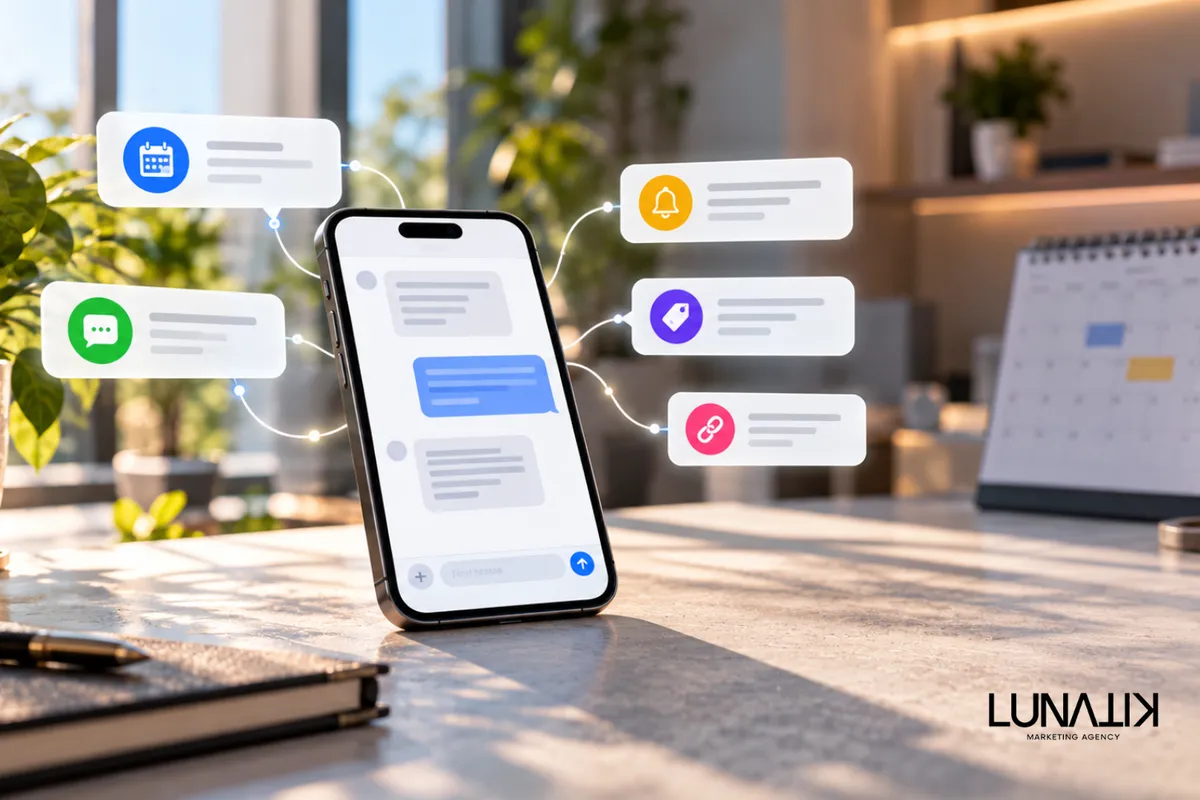
How to use SMS marketing for faster follow-up and bookings
SMS marketing is a direct, measurable way to reach customers with time-sensitive offers, appointment reminders, and quick status updates. Use SMS marketing alongside other channels to shorten lead response time, increase appointment show rates, and keep customers informed without relying on manual outreach. This article focuses on practical tactics for local businesses using Email & SMS Marketing that improve both lead generation and customer experience.
Many local teams struggle with SMS because messages arrive too late, lack clear next steps, or miss consent procedures. Without a connected system that routes leads into the CRM, follow-up is inconsistent and conversion rates suffer. Fast, predictable follow-up and consistent message design reduce friction and increase lifetime value.
Prioritize customer-first rules before automating campaign flows. Lunatik Marketing Agency builds AI-driven systems that combine fast lead routing, template-driven SMS campaigns, and measurable reporting to keep communications timely and useful. The result is fewer missed leads and a clearer path from inquiry to appointment.
Quick Answer
Use SMS marketing for concise, permission-based messages tied to clear customer actions: appointment confirmations, payment reminders, limited-time offers, and brief nurture sequences. Pair SMS with email and phone follow-up inside a CRM so messages trigger automatically from events. For businesses wanting a connected setup, integrate Email & SMS Marketing into existing lead workflows to ensure speed and tracking.
Key Takeaways
- Collect explicit consent and store opt-ins in the CRM before sending messages.
- Keep messages short, action-oriented, and timed to customer needs.
- Automate replies and routing so leads are handled within minutes, not days.
- Use templates and segments to reduce manual errors and maintain brand tone.
- Measure clicks, replies, and downstream bookings to attribute value to SMS campaigns.
Quick Business Snapshot
| Category | Details |
|---|---|
| Best For | Appointment-based local businesses and time-sensitive offers |
| Business Size | Small to mid-size local businesses and multi-location franchises |
| Primary Benefit | Faster response and higher appointment show rates |
| Implementation Complexity | Low to medium depending on CRM integration needs |
| Lunatik Service Fit | Email & SMS Marketing and CRM automation |
| Typical Environment | Point-of-sale systems, booking platforms, and lead capture forms |
Who Should Consider This Solution
- Home service companies that need appointment confirmations and arrival updates.
- Medical and dental practices reducing no-shows with reminders and pre-visit forms.
- Small retailers promoting short-term sales or local events.
- Professional services that require quick intake qualification and scheduling.
- Any business that receives leads online and needs faster CRM-driven follow-up.
Why SMS Works for Local Businesses
SMS works because it meets customers where they already are: on their phones. A short, contextual message tied to a clear action reduces decision friction and brings prospects back into the funnel. The business impact is measurable: better show rates, faster lead qualification, and clearer attribution when messages are tied to booking links or reply keywords. Prioritize messages that solve one problem per text and avoid over-messaging; frequency is a tradeoff between visibility and customer fatigue.
Compliance, Consent, and List Hygiene
Obtain explicit consent and record time-stamped opt-ins in the CRM before sending promotional texts. Business risk and carrier filtering increase when lists contain outdated or purchased numbers. Use double opt-in where practical and provide clear opt-out instructions in every campaign. Clean the contact list regularly by removing unsubscribes and invalid numbers. Accurate consent tracking reduces regulatory friction and keeps delivery rates healthy.
Message Design: Tone, Timing, and Call to Action
Begin with a direct benefit and a clear next step. Messages should include who is sending them, the relevant action, and a single call to action such as a reply keyword, booking link, or confirmation code. Time messages around customer behavior — reminders 24 hours and 2 hours before appointments, follow-ups within an hour after lead submission. Use templates for consistency and A/B test small variations to learn which CTAs drive bookings without overwhelming recipients.
Automation and CRM Integration for Scaled Follow-Up
Automate SMS flows to trigger from events in the CRM: new lead captured, appointment scheduled, payment overdue, or job completed. Integrate text replies with lead routing rules so the right team member receives urgent replies immediately. Use the AI Marketing Workflow to prioritize and tag leads automatically, reducing manual triage. Automation keeps messages timely and ensures every lead enters a predictable nurturing path that can be measured and optimized.
Measuring Performance and Attribution
Track delivery rates, click-throughs, reply volume, and downstream conversions such as bookings or paid invoices. Attribute value to SMS by linking short URLs to tracked landing pages and by capturing reply keywords that map to campaign sources. Use CRM events to tie SMS interactions to lifetime revenue when possible. Small experiments with UTM codes and controlled cohorts reveal which message types drive revenue versus mere engagement.
A Practical Example
Situation: A local HVAC contractor wants fewer no-shows and smoother appointment confirmations. Challenge: Manual calls are time-consuming and inconsistent. Decision: Use SMS for confirmations, an automated reminder sequence, and reply-based rescheduling. Implementation: Capture phone numbers and consent at booking, trigger an immediate confirmation SMS with a calendar link, send a 24-hour reminder, and allow rescheduling via reply or a short booking link. The selected Email & SMS Marketing approach reduces manual labor while keeping the customer informed and able to act quickly.
Comparison: Email vs SMS Marketing
| Channel | Best Use | Typical Speed | Primary Strength |
|---|---|---|---|
| SMS | Time-sensitive reminders, confirmations, quick offers | Immediate | High open and quick responses |
| Detailed content, invoices, newsletters | Hours to days | Rich formatting and attachments |
Practical Checklist
- Collect and store explicit opt-in consent with source tags in the CRM.
- Create short, single-action templates for confirmations and reminders.
- Set automated triggers tied to booking and lead-capture events.
- Configure reply routing and quick response templates for staff.
- Test timing and message variants with small audience segments.
- Track delivery, replies, and downstream bookings through CRM events.
- Review opt-out and deliverability data monthly and clean lists.
What Lunatik Marketing Agency Recommends
Prioritize integration before scale. Connect phone capture and opt-in data directly to the CRM, then automate confirmation and reminder flows that require minimal human intervention. Use SMS for high-value touch points and pair it with email for richer content. Organize campaigns around customer actions, not date-based blasts. Look for automation gaps where AI can tag intent and route leads faster. This creates consistent lead handling, reduces missed appointments, and improves conversion efficiency over time.
Common Mistakes to Avoid
- Sending messages without recorded consent — avoid short-term gains that create long-term compliance risk.
- Over-messaging contacts — set frequency limits to prevent opt-outs and complaints.
- Using unclear CTAs — each message should drive one action only.
- Failing to integrate replies — manual checking of replies causes delays and lost revenue.
- Ignoring deliverability signals — monitor failed sends and carrier rejections to maintain list health.
Businesses looking for additional marketing insights can also read Software We Work With for more practical guidance.
Frequently Asked Questions
How often should a business send SMS messages?
Frequency depends on context: transactional messages like confirmations and reminders are acceptable as needed, while promotional messages should be limited to avoid fatigue. A good rule is no more than one promotional SMS per week for most local businesses and clear opt-out options on every message.
What information must be included for compliance?
Include sender identification, a concise purpose for the message, and a clear opt-out method. Record proof of consent with timestamps and source details in the CRM. Following these steps reduces regulatory risk and improves carrier deliverability.
Can SMS be automated without losing personalization?
Yes. Use templates with dynamic fields pulled from the CRM, such as customer name, appointment time, and technician name. Combine this with behavior-based triggers so messages feel timely and relevant while remaining automated.
How should replies be handled to avoid missed opportunities?
Route replies into the CRM and set priority rules for keywords like YES, BOOK, or HELP. Assign urgent replies to staff alerts and non-urgent responses to nurture sequences. Automating initial acknowledgements helps manage customer expectations while staff review the details.
What metrics indicate a successful SMS campaign?
Key metrics are delivery rate, reply rate, click-through rate on tracked links, and downstream conversions such as bookings or payments. Monitor opt-out rates and complaint volume to balance reach with customer satisfaction.
Final Thoughts on SMS Strategy
Effective SMS marketing works when it answers a single customer need at the right moment and sits inside a connected system. The most reliable gains come from fast lead routing, clear consent, and small iterative tests that improve timing and messaging over time.
Why Trust Lunatik Marketing Agency
| Capability | How It Helps |
|---|---|
| AI-driven marketing approach | Prioritizes leads and automates routine routing |
| Lead generation expertise | Designs capture flows that feed CRM events |
| CRM automation expertise | Connects messages to booking and sales processes |
| Paid advertising management | Supports targeted lists and campaign attribution |
| Website optimization expertise | Creates landing pages that improve SMS conversion |
| Customer-first marketing philosophy | Focuses on helpful, timely communications |
SMS as Part of a System
At Lunatik Marketing Agency, the recommended path combines fast lead routing, explicit consent capture, and template-driven SMS sequences tied to CRM events; integrate short links and reply keywords to measure impact and keep staff focused on high-value interactions while automated flows handle confirmations and reminders. Use this approach to create reliable follow-up without manual overhead and to ensure messages support long-term customer relationships, then Strengthen Customer Communication for clearer outcomes.